
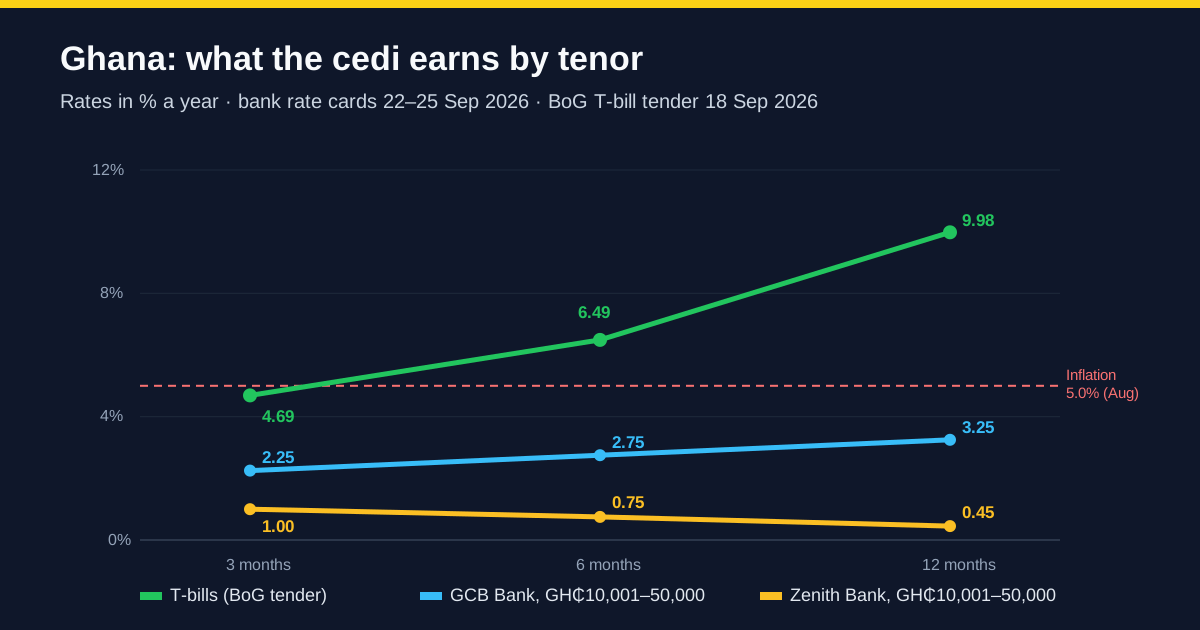

FD-GH-20260927At the end of September 2026, Ghana's big banks post cedi fixed deposit rates between 0.25% and 5.50% a year. The top published figure is GCB Bank's 5.50% for 12 months, and only on more than GH₵1 million. For a typical GH₵10,000–50,000 deposit, the posted rate is 0.45% to 3.25% for a year. Headline inflation was 5.0% in August, so most of these deposits lose purchasing power. The 364-day Treasury bill paid 9.98% at the Bank of Ghana tender of 18 September 2026.
There is a second gap that matters more than which bank you pick. The Bank of Ghana's interest-rate table records the 3-month time deposit rate at 8.68% in August 2026, several times what the rate cards show. The difference suggests that much of the market's term money is priced by negotiation, not by the printed card. A saver who accepts the card is being paid a fraction of what three-month cedi deposits can command.
Why deposits pay so little while the policy rate is 14%
The Monetary Policy Committee cut the policy rate from 25.0% in August 2025 to 14.0% by March 2026. It has held it there since, including at the 132nd meeting, which opened on 23 September 2026. The rest of the market fell much faster than that. The 91-day bill dropped from 11.17% in January 2026 to 4.89% in March, and the 18 September tender cleared at 4.69%. The average lending rate went from 24.15% to 15.94% over the year to August 2026. The Ghana Reference Rate, the base that banks add their loan margins to, is 10.18% from 2 September 2026.
Banks are also awash with deposits. With loan demand weak and reserve rules tied to each bank's loan-to-deposit ratio, an extra cedi of retail term money is worth little to them. That is why the posted cards sit below both the policy rate and short bills. It is also why banks keep a "negotiable" line for large amounts rather than raising the card.
Published rates at four banks, September 2026
Only a handful of Ghanaian banks publish a full cedi rate table. The comparable band below is the one each bank quotes for roughly GH₵10,000–50,000. The last column is the highest rate anywhere on that bank's card, whatever the amount or tenor.
| Bank | Card dated | Lowest tier | 3 months (band) | 12 months (band) | Highest on the card |
|---|---|---|---|---|---|
| GCB Bank | 22 Sep 2026 | GH₵1,000 | 2.25% (GH₵10,001–50,000) | 3.25% | 5.50%, 12 months, above GH₵1m |
| Fidelity Bank | week to 25 Sep 2026 | GH₵20,000 | 1.25% (above GH₵25,000–50,000) | not quoted ("TBD") | 2.65%, 182 days, above GH₵5m |
| Zenith Bank | 22 Sep 2026 | GH₵2,000 | 1.00% (GH₵10,001–50,000) | 0.45% | 2.00%, 3 months, above GH₵1m |
| CalBank | website table, checked 27 Sep 2026 | GH₵5,000 | 0.82% (GH₵30,000–59,999.99) | 0.45% | 1.28%, 3 months, GH₵800,000–999,999.99; above GH₵1m negotiable |
The chart puts the same 3-month rates next to three yardsticks. These are the 91-day bill from the 18 September tender, August's 5.0% inflation, and the 8.68% 3-month time deposit rate in the Bank of Ghana's table.
Stanbic, Absa, Standard Chartered, First National Bank and Access Bank do not post a public cedi fixed deposit table. Standard Chartered opens fixed deposits from GH₵1,000 and First National Bank from GH₵10,000. At all five the rate is agreed when you open the deposit, so the only way to compare them is to collect written quotes for the same amount and tenor on the same day.
Locking in longer usually pays less, except at GCB
Look along each row of the cards and a pattern appears that the headline rate hides. At Zenith, GH₵10,001–50,000 earns 1.00% for three months but only 0.75% for six months and 0.45% for a year. CalBank's card peaks at three months too, with 0.82% on GH₵30,000–59,999.99 against 0.45% for 12 months. Fidelity has stopped quoting a 365-day rate at all. These banks are telling you they do not want to promise today's rate for a year.
The Treasury curve slopes the other way: 4.69% for 91 days, 6.49% for 182 days and 9.98% for 364 days. GCB's card is the only one of the four that rises with tenor, from 2.25% to 3.25% in the same band. At the others, rolling a three-month deposit four times beats a one-year deposit on paper, as long as the card holds when you roll.
GH₵50,000 for a year: what it actually earns
The table applies each 12-month rate to GH₵50,000. It then compares the interest with what 5.0% inflation would take from the same money if prices kept rising at August's pace. Interest is shown gross, because none of these returns is taxed for an individual (see below).
| Where the GH₵50,000 sits | Rate, % a year | Interest after 12 months | Minus 5.0% inflation |
|---|---|---|---|
| 364-day T-bill, tender of 18 Sep 2026 | 9.98 | about GH₵4,990 | about +GH₵2,490 |
| GCB Bank, GH₵10,001–50,000 | 3.25 | GH₵1,625 | −GH₵875 |
| Zenith Bank, GH₵10,001–50,000 | 0.45 | GH₵225 | −GH₵2,275 |
| CalBank, GH₵30,000–59,999.99 | 0.45 | GH₵225 | −GH₵2,275 |
At the posted cards, a year in a bank deposit costs this saver between GH₵875 and GH₵2,275 in real terms. The bill leaves them roughly GH₵2,490 ahead. Treat the bill figure as a snapshot, not a promise. At that tender the government accepted only GH₵110.52 million of the GH₵1,214.08 million bid for 364-day paper, rejecting bids up to 12%. That is a clear sign it will not pay up for long money, and next month's rate can be lower.
Treasury bills: how an individual actually buys them
The weekly auction, usually held on a Friday for settlement the following Monday, is open only to primary dealers. Individuals buy through a depository participant, which in practice means their bank or a licensed broker holding the bill in their name at the Central Securities Depository. Banks such as GCB sell bills to retail customers, several also offer them through mobile channels, and each bank sets its own minimum.
Bills are sold at a discount rather than paying interest along the way. At the 18 September discount rate of 4.6396%, a 91-day bill worth GH₵10,000 at maturity cost about GH₵9,884, which is the 4.69% interest rate quoted in the results. Before maturity there is no penalty schedule as with a deposit. You sell or rediscount the bill through your bank at the market price that day, which can be more or less than you expect.
Tax: nothing is withheld for individuals
Section 7(1)(p) of the Income Tax Act, 2015 (Act 896), added by the Income Tax (Amendment) Act, 2016 (Act 907), exempts interest paid to an individual by a resident financial institution. The same paragraph covers interest on Government of Ghana securities, which includes Treasury bills. A resident company is different: interest paid to it carries 8% withholding tax on account. If your bank has deducted tax from a personal fixed deposit, ask the branch to reverse it and show you the tax code applied.
What the Ghana Deposit Protection Corporation pays if a bank fails
Deposit insurance in Ghana is much thinner than many savers assume. The Ghana Deposit Protection Corporation (GDPC) pays at most GH₵6,250 per depositor per bank. At a specialised deposit-taking institution (a savings and loans company, rural or community bank, microfinance company or finance house) the cap is GH₵1,250. Anything above the cap is claimed from the receiver the Bank of Ghana appoints, and paid only as assets are sold. GDPC must announce payout arrangements within six days of a licence being revoked and aims to pay within 30 days. Depositors then have five more years to claim at its office.
So on a GH₵50,000 deposit, GH₵43,750 depends on the health of the bank itself, not on insurance. The GDPC board began a review of both limits in May 2026, as required by the amendment that received presidential assent on 31 March 2026. The same amendment extended cover to mobile money wallets, each up to GH₵6,250; our guide to mobile money in Ghana explains how wallets are held in trust. Treasury bills sit outside GDPC entirely because they are direct government debt.
This matters for the non-banks that advertise high single-digit or double-digit rates. A finance house or savings and loans company can be licensed and still fail, and there your insured slice is GH₵1,250. Before depositing, check the institution on the Bank of Ghana's list of licensed institutions and look for the GDPC membership certificate, which members must display in every branch.
Breaking a deposit early
Read the liquidation clause before you sign, because at today's rates it can wipe out all the interest. CalBank's published rule is that a cedi deposit liquidated before maturity earns "the negotiated rate less 5%". First National Bank's rules say early withdrawal is not allowed, and any exception is at the bank's discretion with fees that "may reduce your capital amount". If you need part of the money in three months, split it now into two deposits rather than breaking one later.
Rollover works against you as easily. At First National Bank, a matured deposit with no instruction is reinvested automatically for the same period at the rate then prevailing. You get 14 days after renewal to change it. A card that has fallen since you opened means your renewal is quietly repriced down, so diarise every maturity date.
How to get more than the card
Every card in the table carries some form of "rates are subject to change" or "contact treasury for firm quotes". CalBank's card turns to "negotiable" above GH₵1 million. That line is where the gap between a 1% card and the 8.68% in the Bank of Ghana's table gets closed. Ask the branch for the treasury desk's rate on your exact amount and tenor, get it in writing with the liquidation terms, and put the same request to a second bank the same day. Below a few hundred thousand cedis, the realistic choice is between the best card, such as GCB's, and a bill ladder. For cash you may need at short notice, compare these with the best savings accounts in Ghana, where you keep access without a liquidation clause.