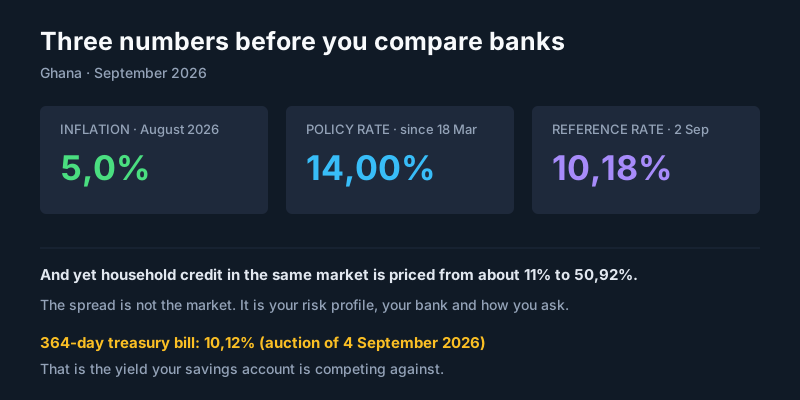

Comparing bank interest rates in Ghana is a crucial financial activity. It involves evaluating various offerings from different banks. This process helps individuals and businesses secure the most favorable terms for their financial needs. Whether you seek a loan, wish to save, or invest in a time deposit, understanding the market is key.
This comparison goes beyond just the headline interest rate. It includes the Annual Percentage Rate (APR), which accounts for all associated fees. Tenor, conditions, and cash flow considerations are also vital. This detailed guide uses up-to-date local sources and Bank of Ghana (BoG) data. It covers essential aspects for a Ghanaian banking customer.
The phrase "compare bank interest rates Ghana" describes this practical approach. It helps you make informed decisions. This ensures your chosen financial product aligns with your risk tolerance and purpose. This guide will clarify how to navigate the Ghanaian financial landscape effectively.
Understanding Interest Rate Comparisons in Ghana
Comparing bank interest rates in Ghana means assessing different financial products. This includes lending rates for loans, overdrafts, and credit cards. It also covers deposit rates for current, savings, and fixed-term accounts. The effective APR is a critical factor, as it incorporates fees, processing charges, and insurance costs.
Ghanaian banks typically quote rates as an Annual Percentage Rate (APR). They often differentiate between secured and unsecured loans. Secured loans, like those for cars or mortgages, usually have lower rates. Unsecured personal loans often come with higher interest charges. The Bank of Ghana (BoG) publishes average lending and deposit rates monthly, providing a useful benchmark.
To compare effectively, first identify your specific need. This could be a personal loan, car loan, business loan, or a fixed-term deposit. Next, shortlist three to five prominent banks such as GCB Bank, Ecobank, Stanbic, Absa, or Fidelity Bank. You should also consider mid-tier banks like GN Bank or GOB Bank. Gather exact rates, APRs, terms, collateral requirements, insurance, and processing fee structures from each. Finally, use a simple spreadsheet or calculator to determine the total cost or total return over the chosen term.
Key Banks and Financial Institutions in Ghana
As of 2026, several universal banks in Ghana are prominent for interest rate comparisons. GCB Bank Limited is a major government-linked institution. It offers personal loans, mortgages, SME loans, and diverse savings and fixed-deposit products.
Ecobank Ghana Limited operates a wide pan-African network. They provide consumer loans, SME loans, overdrafts, and various savings and fixed-term deposit options. Stanbic Bank Ghana Limited emphasizes personal loans, green loans, and business loans. They also offer savings accounts and fixed-term deposits with segmented rates.
Absa Bank Ghana Limited is another key player. They offer personal loans, SME loans, mortgages, and credit cards. Their savings and fixed-term deposit tiers cater to different customer needs. Fidelity Bank Ghana Limited focuses on SME loans, corporate loans, and consumer loans. They are known for competitive savings and fixed-deposit schemes.
Other important institutions frequently used for comparison, especially for lower-rate loans, include Bank of Africa Ghana, Zenith Bank Ghana, and Guaranty Trust Bank (Ghana). Agricultural Development Bank (ADB), Republic Bank Ghana, UBA Ghana, NIB, FNB Ghana, GN Bank, and GOB Bank also play significant roles. Smaller players and microfinance institutions also offer products but typically have higher lending rates and shorter tenors.
Market Overview - April 30, 2026
| Bank | Typical APR (Household Loans) | 3-Month Fixed Deposit Rate |
|---|---|---|
| GCB Bank | 26.3% | 10.5% |
| Ecobank Ghana | 27.9% | 10.1% |
| Stanbic Bank | 25.6% | 10.7% |
| Absa Bank | 27.1% | 10.3% |
| Fidelity Bank | 29.3% | 9.9% |
The Ghanaian financial market closes April 2026 with continued rate stability. The Bank of Ghana's consistent policy stance underpins these trends. Lending rates show a slight downward trajectory, benefiting borrowers. This trend is observed across GCB Bank, Ecobank Ghana, and Absa Bank.
Deposit rates continue their upward momentum, offering better returns for savers. Stanbic Bank and GCB Bank stand out with higher fixed deposit rates. This indicates a healthy competition for deposits. Consumers should take advantage of these favorable conditions.
The Ghana Reference Rate (GRR) reflects the overall easing in the market. This creates a more attractive environment for financial transactions. Always confirm current rates directly with your chosen bank. This ensures accuracy for your specific needs.
Eligibility and Application Process for Financial Products
General eligibility for consumer and SME loans usually requires a minimum age of 18 or 21 years. Some banks may require applicants to be 25 or older for larger personal loans. Proof of employment or a regular income is essential. This can include payslips, bank statements, or business turnover records. A valid ID, such as a Ghana Card, passport, or driver’s licence, is also mandatory. Proof of residence, like a utility bill or tenancy agreement, is also needed.
A good credit history is vital, meaning no serious arrears with the Bank of Ghana’s credit registry. Some banks also cross-check with credit bureaus. For secured loans, title documents, car logbooks, or other collateral documents are required. These ensure the bank has security against the loan.
The typical loan application process begins with online pre-qualification. This helps check estimated rates and eligibility through a bank's website or app. Next, you visit a branch or complete an e-form via the app with full information. You then submit all required documents, including ID, proof of address, income, and any collateral documents. Credit checks and approval usually take 1-5 working days. Finally, an approval offer is provided, detailing the interest rate, APR, term, and conditions. You can then negotiate or decline the offer before disbursement.
Comparing Interest Rates, Fees, Terms, and Conditions
Below is a simplified snapshot reflecting the Ghanaian market in 2026. This data is based on Bank of Ghana figures and local comparison sites. Actual offers can vary based on the bank, customer segment, and collateral provided.
| Bank type / example | Typical APR (household loans) | Key features (fees & conditions) |
|---|---|---|
| Bank of Africa Ghana | Around 16.0% (lowest in recent household-loan rankings). | Often lower-risk-segment focus; may require solid collateral or salary-assignment. |
| GCB Bank | High-to-mid-20s APR for personal loans, higher for unsecured; secured may be mid-teens. | Quick-loan offers with processing fees; may mandate account maintenance and insurance. |
| Ecobank Ghana | Mid-20s–low-30s APR for unsecured loans; lower for secured. | Wide branch network; some packaged offers with mandatory account-maintenance charges. |
| Stanbic Ghana | Mid-20s APR for standard personal loans; lower for green or targeted-segment loans. | Emphasis on structured unsecured loans; may include life or credit-protection insurance. |
| Absa Ghana | Mid-20s APR; can move higher for smaller or unsecured loans. | Offers digital-heavy onboarding; insurance and handling fees often built-in. |
| Fidelity Bank | Mid-20s–mid-30s APR depending on product and risk. | Strong SME focus; may bundle business-account fees with loan pricing. |
On the deposit side, average savings deposit rates were around 7-8% per annum before 2023. These rates have modestly decreased as policy rates eased. Three-month time deposit rates were around 10-12% in 2022-2023. Currently, these rates are somewhat lower but remain attractive against inflation in certain scenarios, according to the Bank of Ghana.
Key differentiators beyond the headline rate include processing or loan origination fees. These often range from 1-3% of the loan amount. Insurance premiums for life or credit protection may also be compulsory. Prepayment penalties or early withdrawal penalties on fixed deposits are important to consider. Grace period structures and whether interest is simple versus compounding also affect the overall cost or return.
Step-by-Step Loan Application Guide
The first step is to define your need clearly. Determine the exact amount required, the purpose of the loan, and your maximum comfortable monthly repayment. This clarity helps in choosing the right product. Next, shortlist three to five banks for comparison. Include major banks like GCB Bank, Ecobank, Stanbic, Absa, and Fidelity Bank. Also consider one or two banks known for potentially lower APRs, such as Bank of Africa Ghana.
After shortlisting, check the current rates and APRs. Visit each bank’s website or app, or contact their customer service. Ask for the all-in APR, the loan tenor, and the typical processing fee range. This ensures you have a complete picture of the costs. Pre-qualify online or through an agent by filling out e-forms or using USSD channels. This provides a preliminary quote without a full credit check.
Prepare all necessary documents. This includes your Ghana Card, proof of address, and 3-6 months of bank statements. If salaried, provide payslips; if self-employed, supply business turnover evidence. Gather any collateral documents if applicable. Submit your formal application either in-branch or via the bank’s app. Wait for approval and review the final offer carefully. Compare the rate, APR, processing fee, insurance, and term with other banks. If the terms are favorable, accept and sign the agreement, then arrange for disbursement. Finally, track your repayments using bank app notifications or SMS alerts to avoid late-payment penalties.
Required Documents and Procedures for Financial Products
Typical documents required for loans across all Ghanaian banks include identification. This means your Ghana Card or passport and driver’s licence. Proof of residence is also mandatory. A recent utility bill, such as water or electricity, or a tenancy agreement will suffice. For proof of income, salaried individuals need 3-6 recent payslips and bank statements. Self-employed individuals or businesses require 6-12 months of bank statements along with business registration documents.
If the loan is secured, collateral documents are necessary. These can include property titles, car logbooks, land documents, or other acceptable security. For larger business loans or certain corporate-linked products, a tax clearance certificate may sometimes be requested. These documents ensure the bank has all necessary information for assessment.
The overall procedure generally involves visiting a branch or initiating the process online. You will then fill out an application form and submit all required documents. The bank will conduct a credit check and approval process, which varies in time. Upon approval, you will receive an offer letter or document. After reviewing and signing, the bank completes the disbursement steps, such as account confirmation or mandate processing.
Benefits, Risks, and Important Considerations
Advantages
- Lower cost of borrowing by choosing banks with lower APRs.
- Better return on savings by opting for higher-yield fixed-term accounts.
- Improved credit discipline when aligning repayments with realistic cash flow.
Disadvantages
- Hidden fees (processing, insurance, mandatory account maintenance) can inflate the true APR.
- Over-indebtedness if "quick cash" is pursued without stress-testing repayment capacity.
- Early-withdrawal penalties on fixed deposits if the term is broken.
- Collateral risk, such as repossession of assets, if loan repayments fail.
When considering financial products in Ghana, always ask for the Annual Percentage Rate (APR). Do not rely solely on the "monthly" or "flat" rate advertised. Confirm whether the interest rate is fixed or variable, as this impacts future payments. Variable rates are linked to policy rate changes by the Bank of Ghana (BoG). This can lead to fluctuations in your repayment schedule. Also, verify if insurance is an optional or mandatory component of the loan. This can significantly affect the overall cost.
It is important to compare the total repayment amount. This includes the principal, interest, and all associated fees. Focusing only on the headline interest rate can be misleading. Understanding the full financial commitment helps in making informed decisions. These considerations are crucial for managing your finances effectively in the Ghanaian market.
Recent Updates, BoG Regulations, and Market Trends
The Bank of Ghana (BoG) plays a central role in the Ghanaian financial market. It publishes average lending and deposit rates monthly. The Ghana Reference Rate (GRR) and interbank rates are also regularly issued. The BoG uses adjustments to its monetary policy rate (MPR) to influence banks’ lending and deposit rates across the country. These actions directly impact the cost of borrowing and the returns on savings for consumers and businesses.
Recent trends from 2023 to 2026 show significant shifts. After a period of very high MPR hikes, reaching over 30%, policy rate easing has begun. This has led to moderate declines in both average lending and deposit rates. Household loan APRs have varied significantly, from approximately 16% at the lowest end to mid-30s% at the highest. This range depends on the risk profile of the borrower and the specific product offered.
The Ghana Reference Rate (GRR) has also seen a downward trend. It has drifted from over 30% to around 23-24% by mid-2025. This rate underpins interbank and loan pricing, influencing overall market stability. Regulatory highlights include BoG requirements for transparent APR disclosure. The central bank also restricts certain abusive practices by financial institutions. Credit registry and risk-weighting frameworks encourage banks to price risk accurately. This ensures "good" borrowers often secure better rates, fostering a fairer lending environment.
Expert Tips and Recommendations for Ghanaian Consumers
Always compare at least three banks before accepting any loan or fixed-deposit offer. This due diligence ensures you secure the most competitive terms available. For loans, use a simple calculator to determine the total repayment. This includes the principal, interest, and all fees over the loan term. For deposits, calculate the total interest earned at different tenors. This helps maximize your returns.
Consider fixed-rate products if you anticipate further policy rate hikes. Fixed rates offer stability in your repayments. Conversely, floating rates may be suitable if interest rates are expected to fall. Building a savings cushion before borrowing is a prudent strategy. Even a small reserve reduces the risk of incurring late-payment penalties. Finally, monitor your credit file through BoG-linked credit bureau partners. This helps avoid unexpected rejections due to adverse credit history. Proactive credit monitoring is essential for financial health.
Common Problems and Solutions in the Ghanaian Market
| Problem | Common in Ghana | Practical solution |
|---|---|---|
| APR not clearly disclosed | Some banks advertise “low rates” but hide fees in fine print. | Insist on a written APR quote and ask for breakdown of all fees. |
| Approval delays or ghosting | Applicants wait days without updates. | Confirm expected turnaround; escalate to branch manager or call head-office. |
Expert Analysis - April 30, 2026
The persistent stability and slight easing of rates indicate a mature and well-managed financial market in Ghana. This environment is ideal for long-term financial planning. Borrowers can seek out personalized loan offers with confidence, knowing the market is competitive.
Savers are in a strong position to optimize their returns. Fixed deposits, particularly from Stanbic Bank and GCB Bank, are offering compelling yields. This is an opportune time to review and potentially restructure savings portfolios. Maximize your earnings on the Ghanaian cedi.
Banks are increasingly leveraging data analytics to tailor product offerings. This means individual credit profiles can unlock specific benefits. We advise maintaining a strong credit history. This improves your chances of securing the most favorable interest rates.


