

GHBOGFX2611The Bank of Ghana exchange rate is a benchmark, not a price you can buy dollars at: it is calculated from deals of US$10,000 or more between banks and their large clients, and banks and forex bureaus sell to the public above it. The rates below come from the Bank of Ghana daily interbank table and update automatically every business day.
On 27 November 2026 the Bank of Ghana interbank rate for the US dollar was GH¢11.8400 (buying GH¢11.8341, selling GH¢11.8459), weaker for the cedi than the previous published day (GH¢11.8300). This is a benchmark from trades between banks: banks and forex bureaus sell dollars to the public above it.
| Currency | Buying (GH¢) | Selling (GH¢) | Mid rate (GH¢) |
|---|---|---|---|
| US Dollar (USD) | 11.8341 | 11.8459 | 11.8400 |
| Pound Sterling (GBP) | 15.5097 | 15.5264 | 15.5181 |
| Euro (EUR) | 12.9496 | 12.9625 | 12.9561 |
| Swiss Franc (CHF) | 14.1538 | 14.1665 | 14.1602 |
| Canadian Dollar (CAD) | 8.3033 | 8.3114 | 8.3074 |
| Yuan Renminbi (CNY) | 1.7783 | 1.7797 | 1.7790 |
| Japanese yen (JPY) | 0.0742 | 0.0743 | 0.0743 |
| South African Rand (ZAR) | 0.6805 | 0.6809 | 0.6807 |
| Australian Dollar (AUD) | 7.8619 | 7.8704 | 7.8662 |
Source: Bank of Ghana, daily interbank FX rates for 27 November 2026 (weighted median USD rate GH¢11.8400), cross-checked against market feeds. Updated automatically every business day.
How the Bank of Ghana rate is set
Every business day, licensed commercial banks report their spot dollar-cedi deals concluded before the 15:30 GMT cut-off: trades on the interbank market and transactions with clients of US$10,000 or more. The Bank of Ghana works out the day's reference rate from those deals as a weighted median and publishes it at 16:30 GMT on its website and on Reuters and Bloomberg. Because the figure only exists after the market closes, the rate shown for today is always the latest published business day.
What the gap to your bank or forex bureau costs
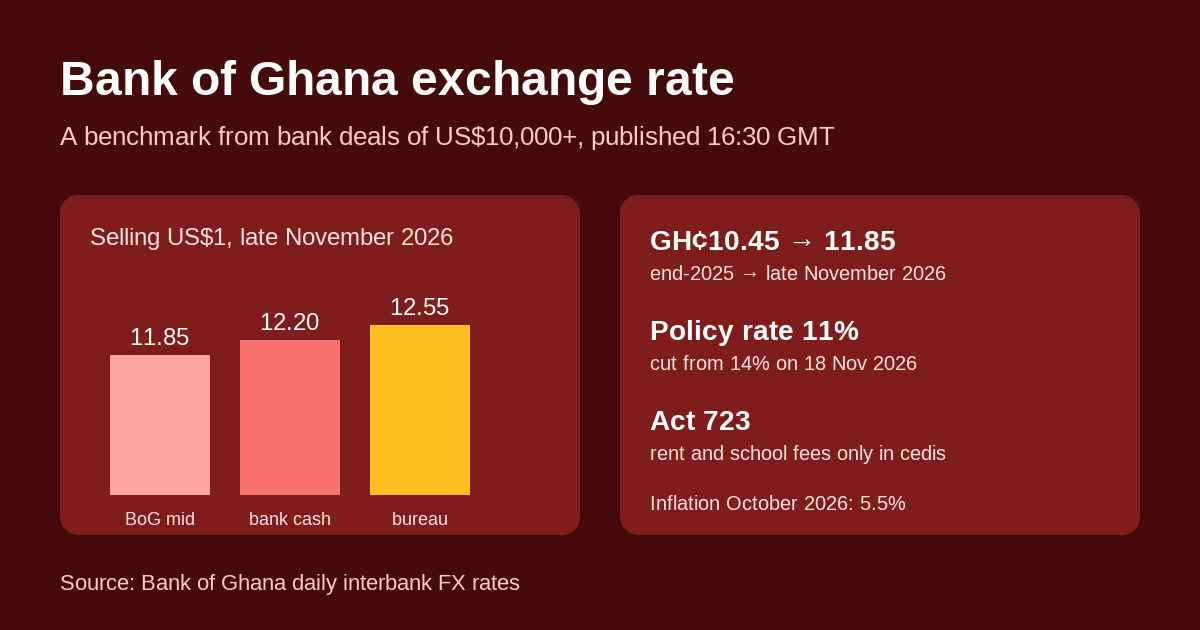
Banks and bureaus add their margin to the benchmark, and bureaus, which handle small cash amounts, add the most. In late November 2026, when the Bank of Ghana mid rate was GH¢11.85, one commercial bank sold dollar transfers at GH¢11.985 and cash at GH¢12.20, and retail bureaus were selling at GH¢12.55, more than 5% above the benchmark. Card payments for foreign subscriptions were billed at around GH¢12.67 to GH¢12.77, while remittance apps converting money sent to Ghana paid close to the interbank rate. Type the rate you are offered into the converter to see the difference in cedis.
The cedi in 2026
The cedi ended 2025 at GH¢10.45 per dollar on the interbank market, was at its strongest in February at around GH¢10.69 and weakened through the year to about GH¢11.85 in late November; reported year-to-date depreciation reached about 10.6% by November. Gold carried the external accounts, at about two thirds of export receipts between January and October, but softer world gold prices and less dollar supply from the state gold buyer added pressure late in the year. At home, inflation fell to 5.5% in October, below the 8% ± 2 target band, and the Monetary Policy Committee cut the policy rate from 18% to 15.5% in January, to 14% in March and to 11% on 18 November 2026. Lower cedi interest rates make holding cedis less rewarding, which is one reason the currency softened; if you keep savings in cedis, compare Treasury bill rates before deciding.
Rules worth knowing
- Prices must be in cedis. Under the Foreign Exchange Act, 2006 (Act 723) and Bank of Ghana notice BG/GOV/SEC/2025/26, the cedi is the only legal tender: rent, school fees, property and car sales and other domestic contracts may not be priced or paid in dollars. Foreign-currency invoices are allowed only for expatriates and non-residents, and the exchange rate on them must be benchmarked against the Bank of Ghana reference rate.
- Use licensed dealers only. Bureaus must display their Bank of Ghana licence, ask for valid photo ID such as the Ghana Card or a passport, and issue an official receipt for every transaction; street dealing is illegal under Act 723.
- Travel allowance. If you buy foreign currency over the counter for a trip without a foreign currency account, the limit is US$10,000 or its equivalent per person per trip, with a passport, visa and confirmed ticket.