
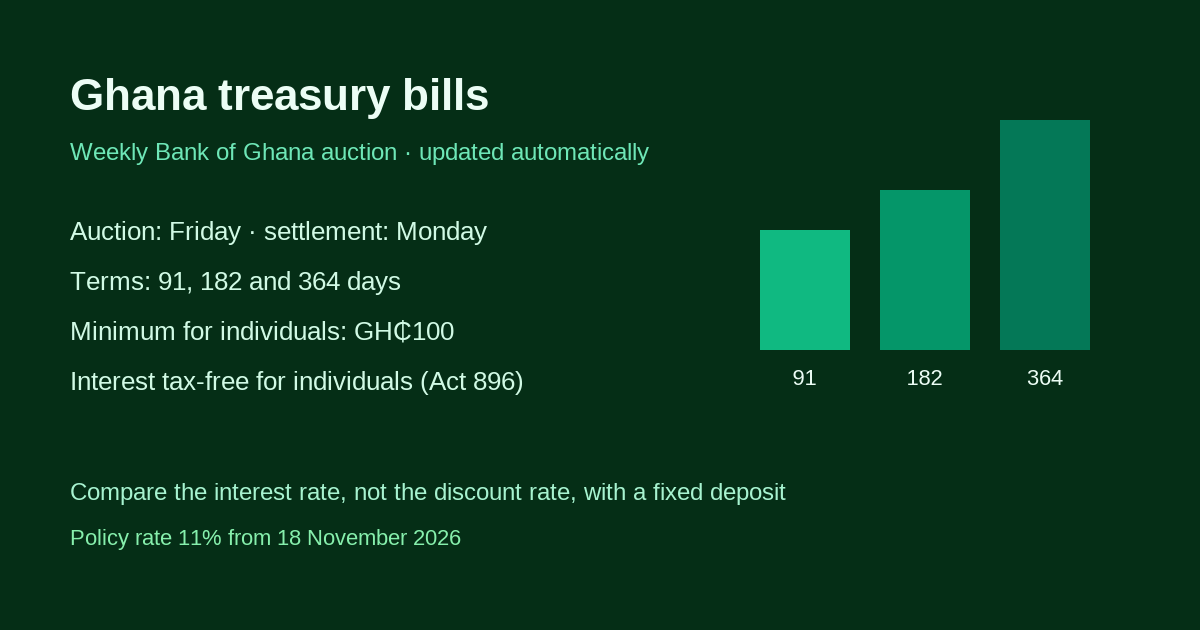

GHTBILL2611Ghana's treasury bill rates are set every week at the Bank of Ghana auction, and the table below updates after each one. The figure to compare with a fixed deposit is the interest rate, not the discount rate, and for individuals the interest is tax-free: under the Income Tax Act, 2015 (Act 896) it is exempt, and the 8% withholding tax on interest does not apply.
At the auction settled on 23 November 2026 (tender 2034), the Bank of Ghana sold the 91-day bill at an interest rate of 4.5193 %, the 182-day bill at 6.1210 % and the 364-day bill at 9.4470 %. The interest rate is the yearly return you actually earn; the discount rate is only used to work out the price you pay today.
| Bill | Discount rate | Interest rate (your return) | You pay for GH₵1,000 | You earn at maturity |
|---|---|---|---|---|
| 91 days | 4.4688 % | 4.5193 % | GH₵988.83 | GH₵11.17 |
| 182 days | 5.9392 % | 6.1210 % | GH₵970.30 | GH₵29.70 |
| 364 days | 8.6316 % | 9.4470 % | GH₵913.68 | GH₵86.32 |
Source: Bank of Ghana treasury bill rates, updated automatically after each weekly auction. Prices use the 364-day year applied to Ghana bills; brokers and banks may add their own fees.
Discount rate or interest rate: which one is your return
A treasury bill pays no coupon. You buy it below its face value and receive the full face value when it matures, and the difference is your income. The discount rate expresses that difference as a share of the face value; the interest rate expresses it as a share of what you actually paid, so it is always a little higher. Because your money is the price you paid, the interest rate is the one that matches a savings account or a fixed deposit. Ghana bills use a 364-day year, which is why the prices in the table divide the term by 364.
The gap between the two rates grows with the term. On a 91-day bill they differ by only a few hundredths of a point, but on a 364-day bill the interest rate is close to a full point above the discount rate, because you hand over noticeably less money up front for the same GH₵1,000 at maturity.
How the weekly auction works
The Bank of Ghana holds the auction on Fridays and the bills settle on the following Monday, which is the issue date shown in the table. Only authorised primary dealers bid directly. Individuals take part through them as non-competitive bidders, which means you accept the average rate set at the auction rather than naming your own. Your bill is recorded electronically at the Central Securities Depository in your name, opened with your Ghana Card or passport; you never receive a paper certificate.
How to buy treasury bills as an individual
- Through your bank. Universal banks such as GCB, Ecobank, Absa, Stanbic, Fidelity and CalBank submit bids for customers, at the branch or in their apps. Branch minimums are often GH₵500 to GH₵1,000.
- Through a licensed broker. Securities houses such as Databank, IC Securities and SIC Brokerage open an account for you without a bank account at the same institution.
- From your phone. Ecobank's TBill4All runs on MTN Mobile Money through the USSD code *770#, and several regulated investment apps sell bills from GH₵10. The Bank of Ghana's own minimum for retail investors is GH₵100.
Whichever channel you use, check the fee before you buy: on a 91-day bill a charge of even 0.2% removes a noticeable part of a quarter's income. If your aim is to keep cash safe for a few months, compare the result with fixed deposit rates in Ghana, which banks set themselves and can beat short bills.
Why rates are much lower than in 2024 and 2025
T-bill rates follow inflation and the Bank of Ghana's policy rate. Headline inflation fell from 23.8% in December 2024 to 5.4% in December 2025 and reached a low of 3.2% in March 2026, before edging up to 5.5% in October 2026. The Monetary Policy Committee cut the policy rate from 28% in June 2025 to 18% by December 2025 and 14% in 2026, and on 18 November 2026 it cut it again by three points, to 11%. With inflation now below the 8% ± 2 target band, investors no longer demand the risk premium that pushed bill rates above 25% two years earlier.
The chart shows how the latest auction compares across terms and how the 91-day rate has moved over recent weeks.
The longer bill pays more because you lock your money in for a year. After the November rate cut, a 364-day bill fixes today's return for the whole year, while a 91-day bill will be reinvested at whatever rate the next auctions set.
Selling a bill before it matures
You are not stuck until maturity. Banks and brokers can rediscount a bill, buying it back before the due date, but you give up part of the interest you would have earned, and some platforms refuse to rediscount in the last week before maturity. A bill can also be sold on the secondary market; if rates have risen since you bought it, buyers will only pay a lower price, and you can make a loss. Fees and spreads vary by institution and are rarely published, so ask for the exact amount you would receive before you decide. Money you may need at short notice is often better kept in a savings account with instant access.